A wet line between the fire and the farm.
Rainmaker® modules deployed along boundaries, sheds and packhouses to hold a continuous wetted perimeter around working farmland.
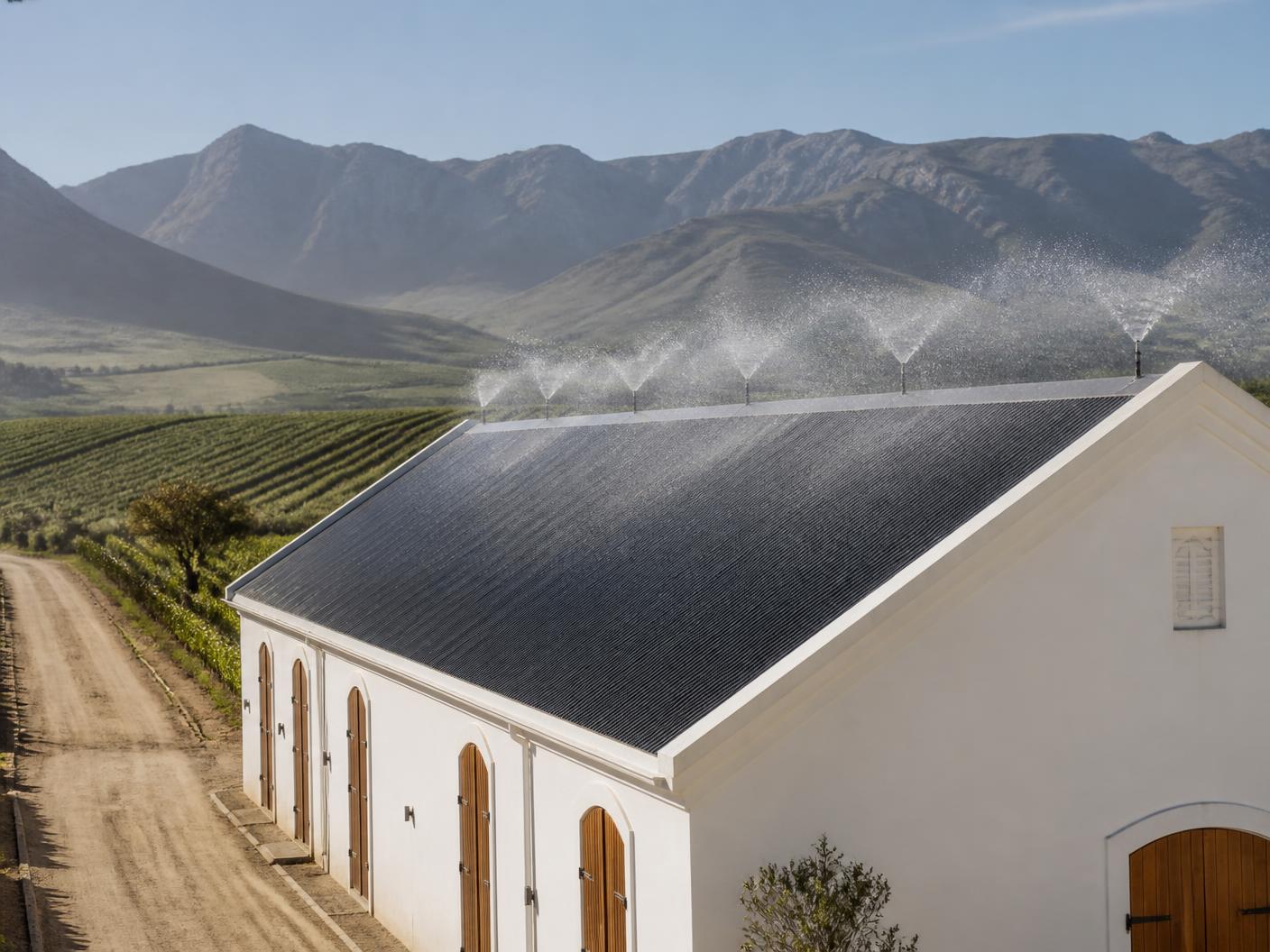
Perimeter thinking, not just roofs.
On a farm the exposure is rarely one building. It is the packhouse, the machinery shed, the boundary where dry veld meets the block. Rainmaker® Agri uses the same 6-metre module along those lines, forming a continuous wetted band rather than protecting a single roof.
Long-throw nozzles carry water across the perimeter, and the system runs from whatever the farm already has — borehole, dam, reservoir or municipal line — with a pressure pump where supply sits below the operating minimum.
Long-throw nozzles
Two heads per module, tuned to reach across a perimeter band.
Any water source
Borehole, dam, reservoir or municipal supply, with pump sizing to suit.
Perimeter or roof runs
Deploy along boundaries, or on shed and packhouse ridges.
UV-stable materials
Built for permanent outdoor exposure in high-UV conditions.
Sectional maintenance
Individual modules can be isolated and serviced without dropping the run.
Simple seasonal checks
Pre-season flow test at the pump confirms the run before fire season.
Hold the line, then hold it longer.
Start the pump
Farm pump or borehole feed brings the perimeter run up to operating pressure.
Feed the run
Joined 6-metre modules distribute flow along the boundary or building line.
Wet the band
Long-throw heads lay down an overlapping wetted band across the perimeter and adjoining ground.
Sustain through the burn
Maintain flow while the front and ember fall pass, then shut down at the pump.
Protects the season, not just structures
Vineyards, orchards and stored crop represent a year of work — a wetted perimeter defends the whole block.
Runs off farm water
Borehole, dam or tank supply with a booster pump. No dependency on municipal pressure.
Covers outbuildings too
The same modules protect packhouses, machinery sheds and workers' housing roofs.
Deployed where risk changes
Modules can be extended or reconfigured as blocks, fence lines and fuel loads change.
Perimeter module run.
Modules joined end-to-end along a boundary line. Long-throw heads maintain an overlapping wetted band across the perimeter.
Agricultural configuration data.
Perimeter length, pump duty and total flow are confirmed per farm in the Preliminary Protection Design Report.
Module & nozzle configuration
- Module length
- 6 m
- Flexible sprinkler heads per module
- 2 (long-throw nozzle)
- Nozzle type
- Long-throw, wind-resistant large-droplet
- Perimeter per module
- 6 m, joined end-to-end
- Nominal flow per module
- ≈ 1 500 L/h
Mounting & installation
- Mounting position
- Shed and packhouse ridges, or perimeter posts and walls
- Bracket
- UV-stabilised PVC bracket for permanent outdoor exposure
- Fixing method
- Screw-fixed and epoxy bonded
- Serviceability
- Individual modules isolated without dropping the run
- Installation route
- Farm maintenance team or plumber
Coverage
- Spray radius (per sprinkler head)
- 12 metres
- Coverage pattern
- Continuous overlapping wetted band along the run
- Protected zone
- Building roof plus adjoining ground and fuel load
- Run strategy
- Sustained through the front and following ember fall
Water supply & flow requirements
- Minimum operating pressure
- 2 bar at inlet
- Typical source
- Borehole, dam, reservoir or farm storage
- Booster pump
- Farm pump duty confirmed against run length
- Pre-season check
- Flow test at the pump before fire season
- Control
- Manual valve at the pump or header
- Perimeter runs are laid out against the prevailing fire approach, not around the full property boundary.
- Runs can be extended or reconfigured as blocks, fence lines and fuel loads change between seasons.
- Pump duty, not module count, usually sets the practical run length on farm supplies.
Specified for these environments.
- Barns, machinery sheds and implement stores
- Packhouses, cold stores and processing buildings
- Workers' housing and farmstead roofs
- Boundary lines where veld meets vineyard or orchard blocks
- Farmyard perimeters and fuel or feed storage areas
- Crop irrigation duty — the configuration is specified for protection saturation
Map your perimeter.
Enter perimeter or ridge length and your water source. The System Designer returns module count, pump requirement and total price.