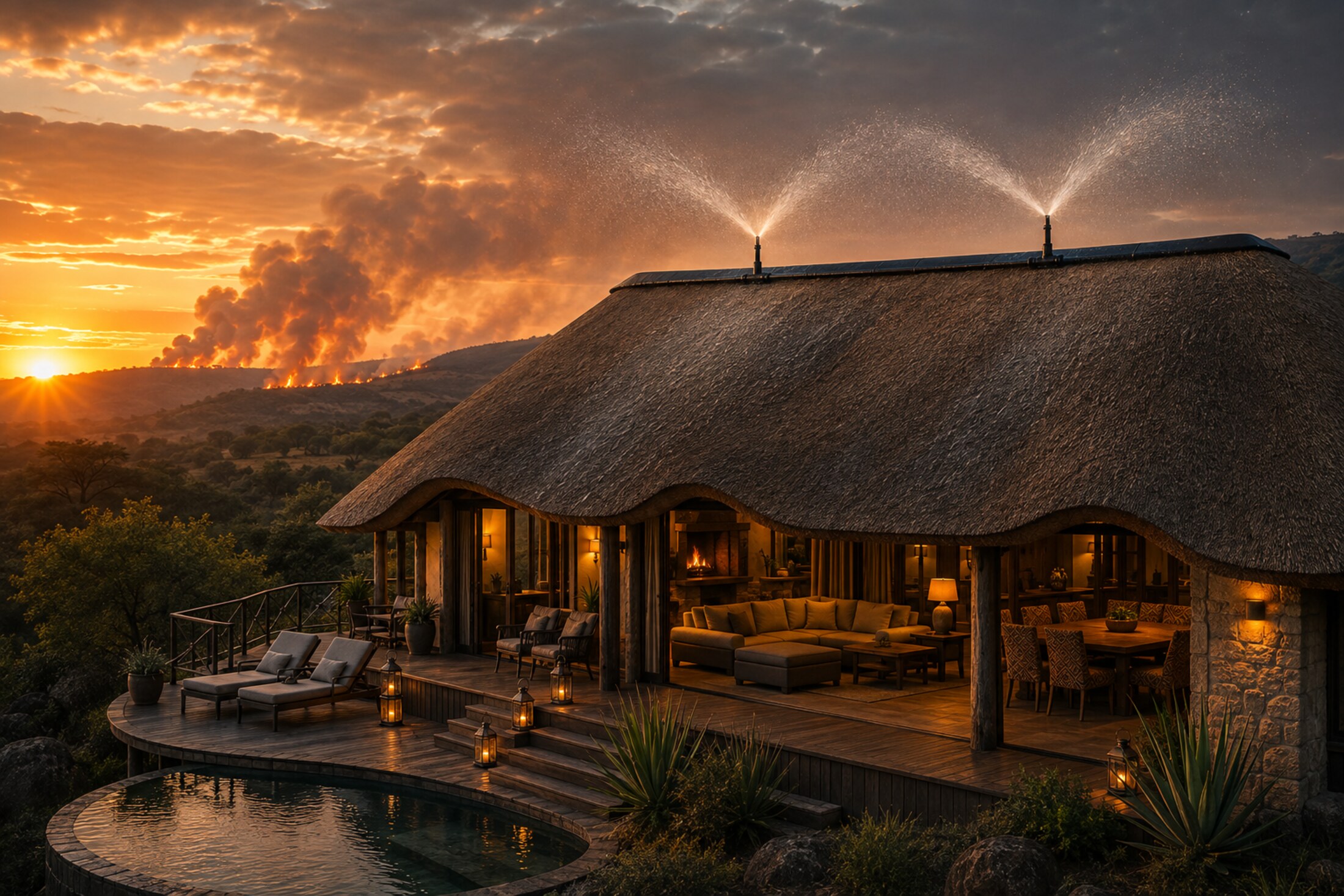
Thatch does not get a second chance.
A higher-flow Rainmaker® configuration for thatch, lodges and safari properties, where a single ember in dry reed ends the building.
Saturation beats suppression on organic roofs.
Thatch behaves nothing like tile or sheet metal. It is deep, organic and porous, and once it takes hold internally there is no putting it out from the outside. The only reliable defence is water in the reed before the fire arrives.
Rainmaker® Thatch keeps the same 6-metre modular chassis and mounts along the crest, but the heads are re-nozzled for the higher flow demand and steep pitch of thatch — carrying water down the full slope instead of running off the top layer.
Wets the depth, not the surface
Thatch nozzles deliver sustained volume so water works into the reed layer rather than sheeting off the crown.
Protects irreplaceable buildings
Hand-laid thatch, boma structures and heritage roofs cannot be rebuilt quickly or cheaply — prevention is the whole strategy.
Guest-safe and silent
No alarms, no plant room, no visible hardware from guest level. Manual activation by lodge staff.
Works off borehole or tank
Remote properties run the system from stored water with a booster pump — no municipal supply needed.
Wet the reed before the front arrives.
Activate early
On a lodge, activation is a standing procedure: staff open the valve as soon as a fire front is reported in the area.
Crest distribution
Water is carried along the crest through joined modules and released across both slopes.
Deep saturation
High-flow thatch nozzles keep the reed wet down the pitch, denying embers a dry ignition point.
Sustain and stand down
Maintain flow through the ember-fall period that follows the front, then close the valve.
Engineered for reed, not tile.
Thatch-specific nozzles
Higher flow per head to match the absorption rate of organic roofing.
Crest-mounted modules
Fixed along the ridge crest with UV-resistant PVC brackets and epoxy bonding.
Both-slope coverage
Overlapping domes carry water down steep pitches on either side of the crest.
Tank and borehole ready
Designed to run on stored water with an appropriately sized pressure pump.
Boma and outbuilding runs
Separate module runs protect bomas, decks and detached suites.
No penetrations through thatch
Mounting hardware fixes to structure and crest detail, not by piercing the reed field.
Thatch crest installation.
Module run along the thatch crest. Two re-nozzled heads per 6-metre section deliver sustained volume across both slopes of the pitch.
Thatch configuration data.
Flow demand scales with module count and is confirmed per property in the Preliminary Protection Design Report.
Module & nozzle configuration
- Module length
- 6 m
- Flexible sprinkler heads per module
- 2 (thatch nozzle)
- Nozzle type
- High-volume thatch nozzle, large-droplet
- Nominal flow per head
- ≈ 750 L/h
- Design bias
- Sustained volume over throw distance
Mounting & installation
- Mounting position
- Thatch crest, parallel to the ridge
- Bracket
- UV-stabilised PVC bracket on crest structure
- Fixing method
- Epoxy-bonded to structure, no reed penetration
- Pitch range
- Suited to steep thatch pitches
- Installation route
- Registered plumber recommended on lodge roofs
Coverage
- Spray radius (per sprinkler head)
- 12 metres
- Coverage pattern
- Overlapping domes across both slopes from the crest
- Saturation objective
- Wetting into the reed layer, not surface run-off
- Recommended pre-front run time
- Activate on first fire-front report
Water supply & flow requirements
- Minimum operating pressure
- 2 bar at inlet
- Typical source
- Borehole, storage tank or reservoir
- Booster pump
- Normally required on stored-water sites
- Reserve planning
- Sized for sustained run through ember fall
- Control
- Manual valve, standing lodge procedure
- Thatch cannot be extinguished from the outside once internal ignition occurs; the configuration is specified for pre-wetting only.
- Separate module runs are specified for bomas, decks and detached suites so each structure can be activated independently.
- Water reserve, not module count, is usually the limiting factor on remote lodge sites.
Specified for these environments.
- Thatched homes, cape reed and grass roof coverings
- Luxury safari lodges, resorts, eco-lodges and hospitality properties
- Heritage and hand-laid thatch roofs
- Steep-pitch thatch requiring saturation down both slopes
- Remote properties operating from stored or borehole water
- Fixing hardware through the reed field — brackets fix to crest structure only
Specify your thatch system.
Give us the crest length, pitch and water source. The System Designer returns the configuration, flow requirement and price for the property.